
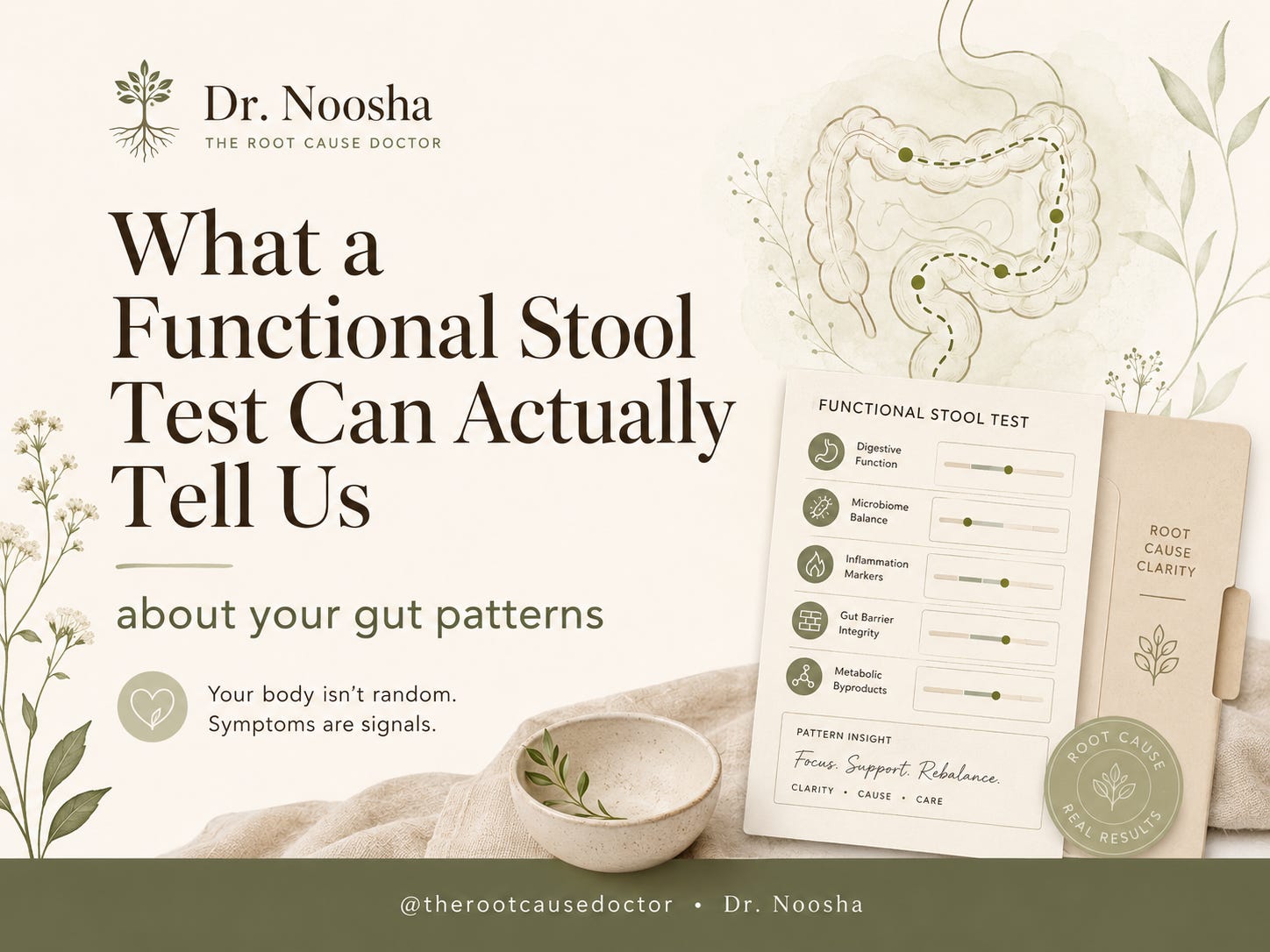
What a Functional Stool Test Can Actually Tell Us About Your Gut
If bloating, constipation, food reactions, skin flares, brain fog, or fatigue keep showing up together, functional stool testing may help us understand what your gut is trying to signal.

And why I don’t use testing to chase every symptom — I use it to understand the pattern.
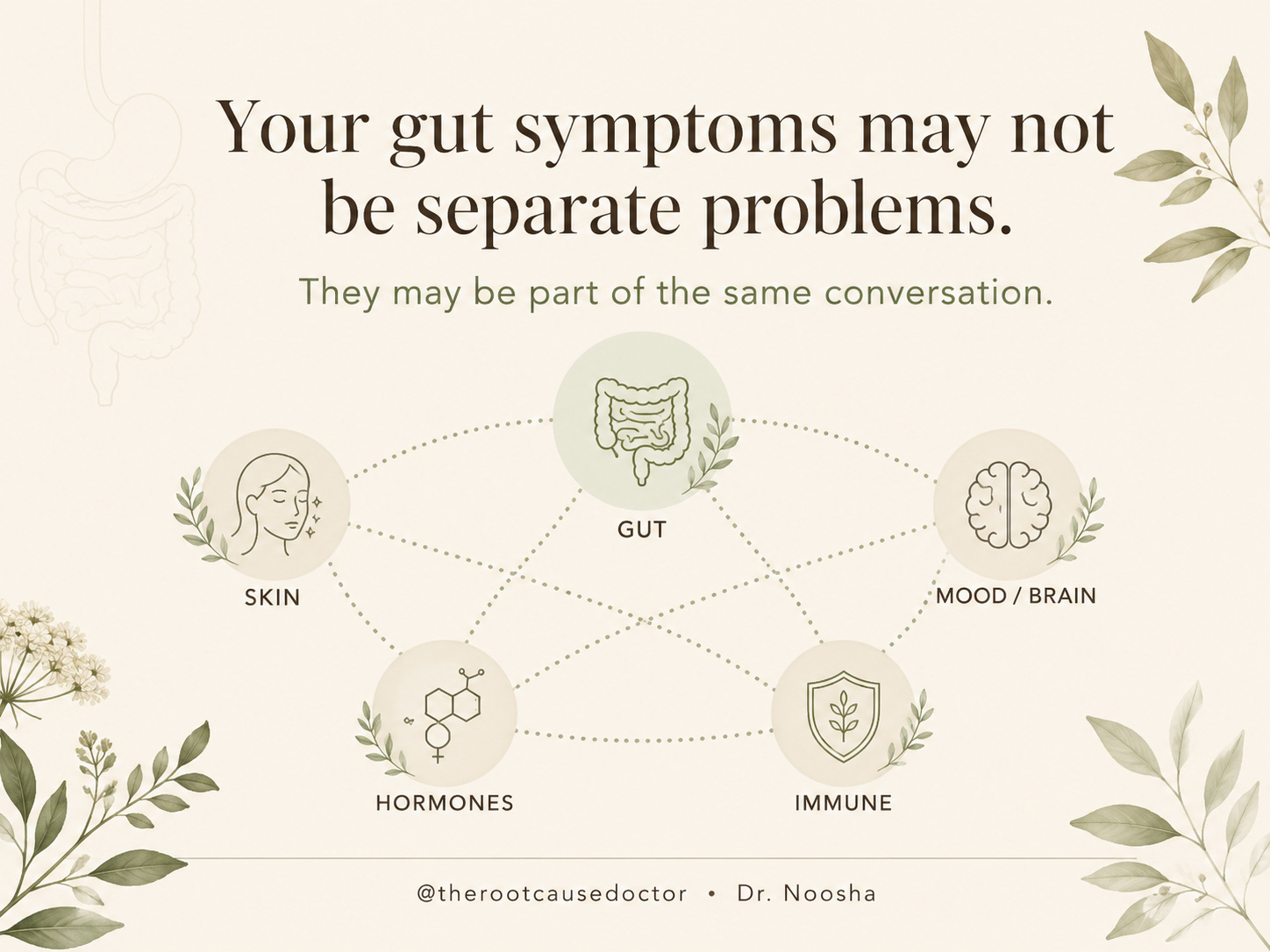
Your gut symptoms may not be random.
Bloating. Constipation. Loose stools. Reflux. Urgency. Food reactions. Skin flares. Brain fog. Fatigue. Mood changes. Hormonal symptoms.
They can feel like separate problems.
But sometimes, they are part of the same conversation.
Your body may be saying:
Something is not being digested well.
Something is irritating the gut lining.
Something is inflamed.
Something is overgrown.
Something is under-supported.
Something is not clearing well.
Something in the gut terrain needs attention.
And this is where functional stool testing can be helpful.
Not because one test gives us every answer.
Not because we should treat every single thing that shows up.
And not because your body is broken.
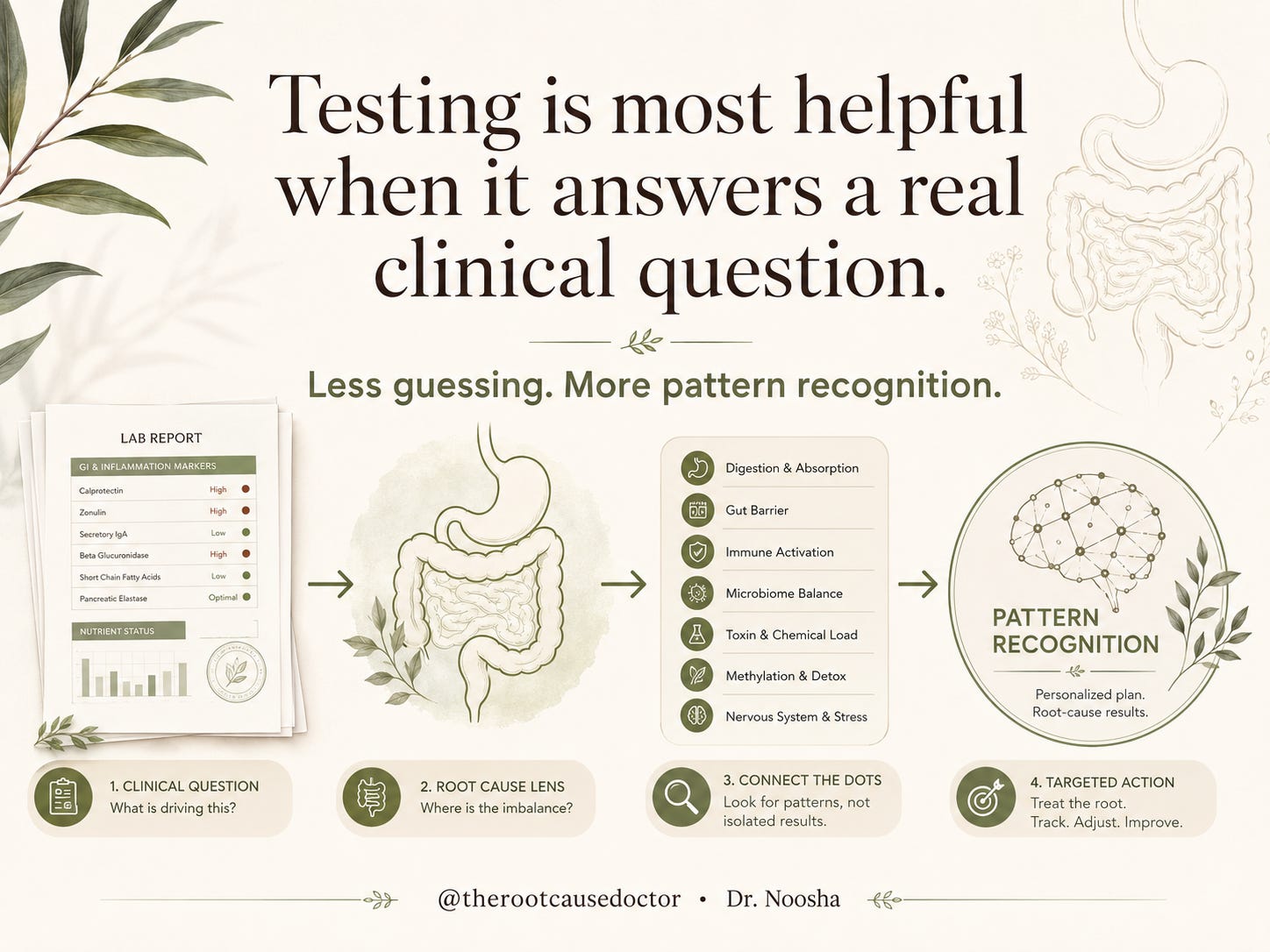
But because, when used thoughtfully, stool testing can help us move from guessing to pattern recognition.
It helps us ask a better question:
What is the gut trying to show us?
Why stool testing matters
In functional medicine, we are not only asking:
Do you have a diagnosis?
We are also asking:
What is the terrain like?
How is digestion functioning?
Is there inflammation?
Is the microbiome imbalanced?
Is the immune system activated in the gut?
Is the body absorbing well?
Is bile, enzyme, or stomach acid support part of the picture?
Is the nervous system affecting motility and digestion?
A conventional stool test may be used to look for infection, blood, inflammation, parasites, or other medically important concerns.
A functional stool test often goes wider.
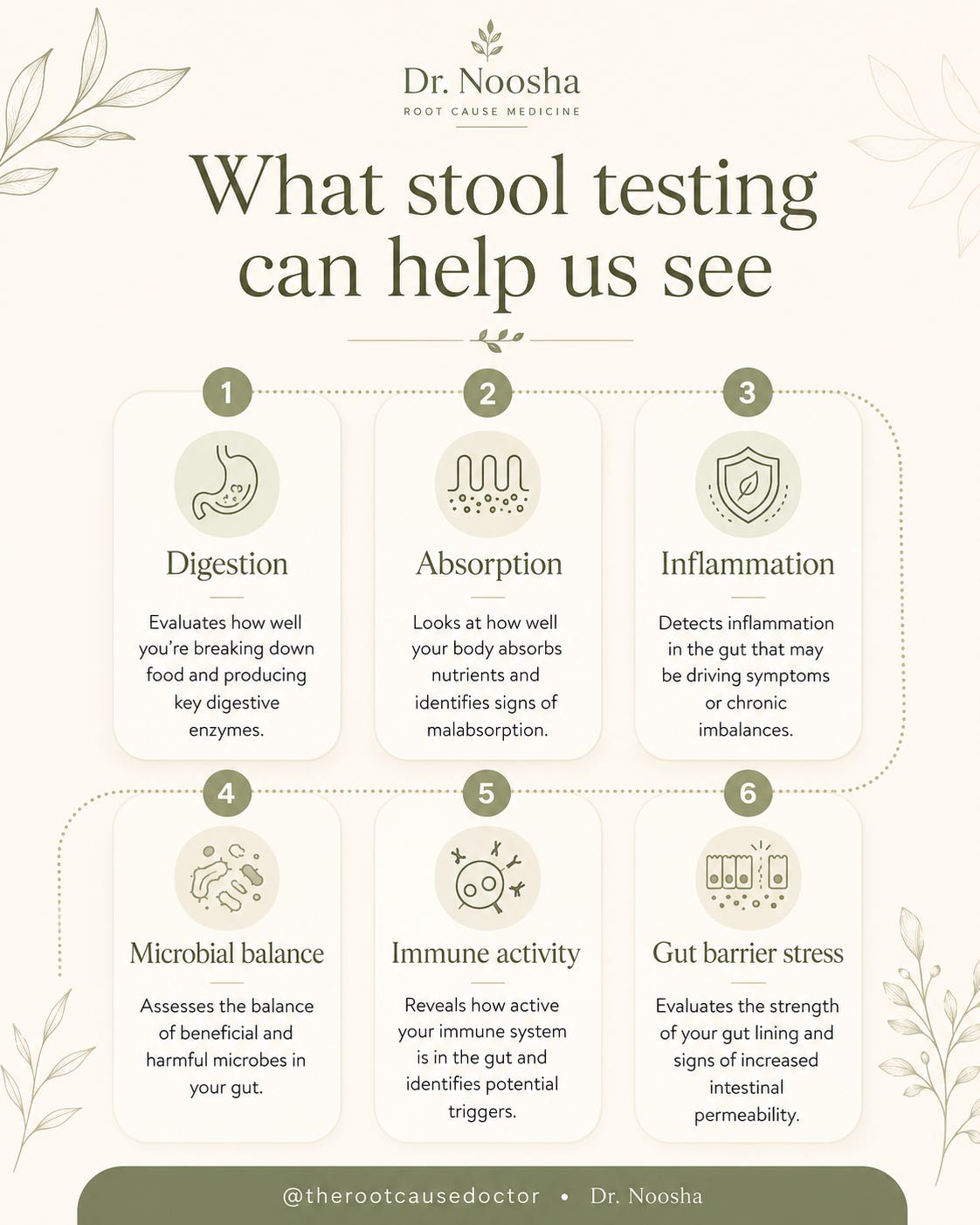
Depending on the panel, it may include markers related to digestion, absorption, inflammation, immune activity, microbial balance, yeast, parasites, opportunistic bacteria, beneficial bacteria, short-chain fatty acids, pancreatic enzyme output, and sometimes gut barrier stress.
This does not mean functional testing is “better” in every situation.
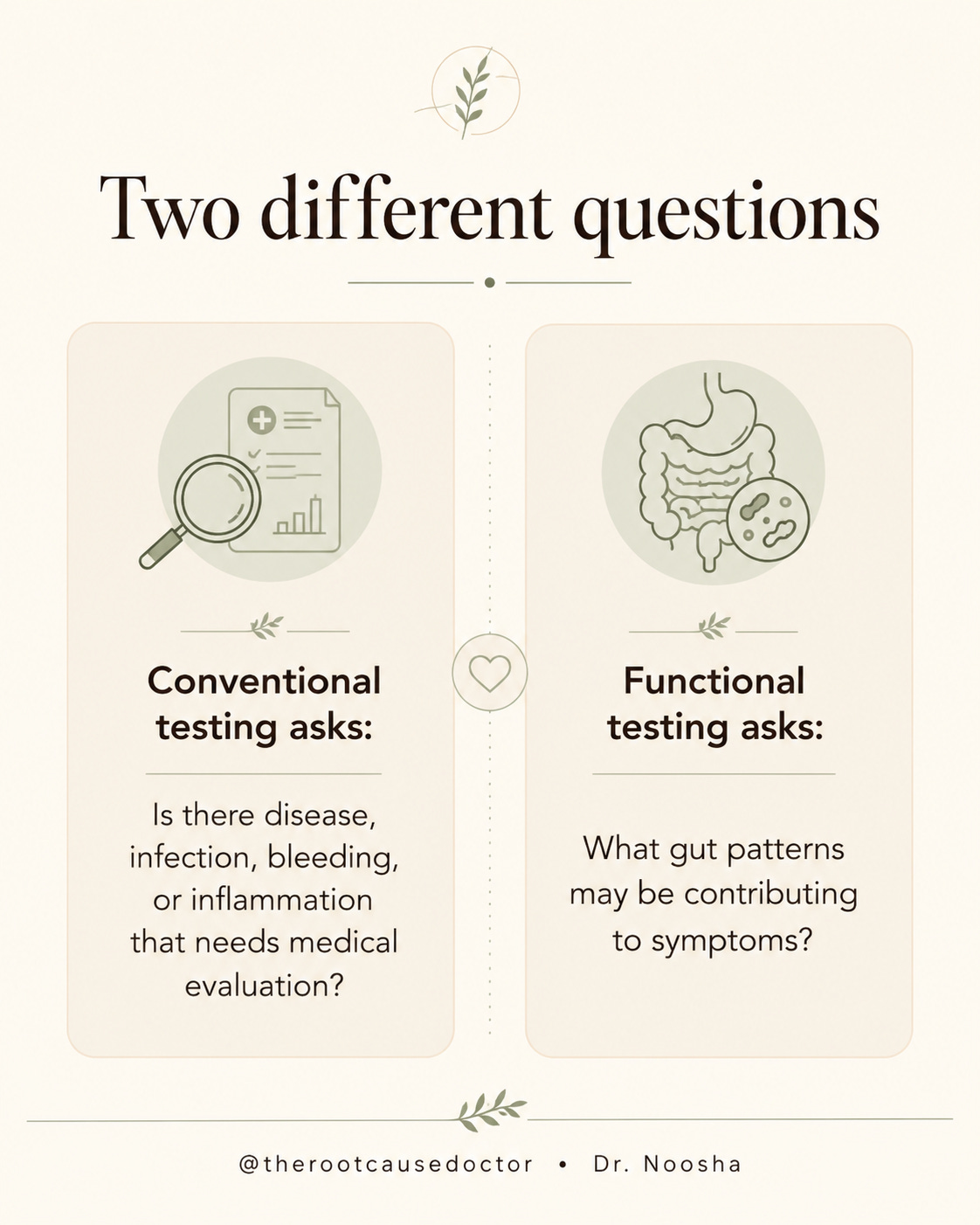
It means it is asking a different kind of question.
Conventional testing often asks:
Is there disease, infection, bleeding, or inflammation that needs medical evaluation?
Functional testing often asks:
What patterns are showing up in the gut environment that may be contributing to symptoms?
Both can matter.
The wisdom is knowing when each one is appropriate.
I’m not looking for one “bad bug”
When I review a stool test, I am not just looking for one organism to blame.
I am looking for the pattern.
Because the gut is an ecosystem.
And symptoms often come from the relationship between many factors, not one isolated finding.

A stool test may help us understand several major categories.
1. Digestion and absorption
Before we talk about the microbiome, we have to talk about digestion.
Because if food is not being broken down well, the downstream gut environment changes.
Some stool tests may give clues about:
pancreatic enzyme output
fat digestion
protein breakdown
carbohydrate fermentation
malabsorption patterns
stool consistency
transit time
This matters because many people jump straight to probiotics, antimicrobials, or “gut healing” supplements without asking whether the body is digesting well in the first place.
If someone has bloating after meals, greasy or floating stools, nausea with fatty foods, nutrient deficiencies, or a heavy feeling after eating, I may be thinking about digestion, bile flow, enzymes, stomach acid, motility, and meal rhythm.
Not as a diagnosis from symptoms alone.
But as a pattern to investigate.
Because sometimes the gut does not need more things added.
Sometimes it needs better breakdown, better flow, and better timing.
2. Inflammation in the gut
Inflammation is one of the most important patterns to pay attention to.
Some stool tests include inflammatory markers such as calprotectin, lactoferrin, occult blood, or other inflammatory clues depending on the lab.
These markers can help us understand whether the immune system may be activated in the intestinal tract.
And this is important:
Not all bloating is “just bloating.”
Not all diarrhea is “just IBS.”
Not all gut discomfort should be treated with herbs and supplements.
Sometimes inflammation is a signal that the body needs a more complete medical evaluation.
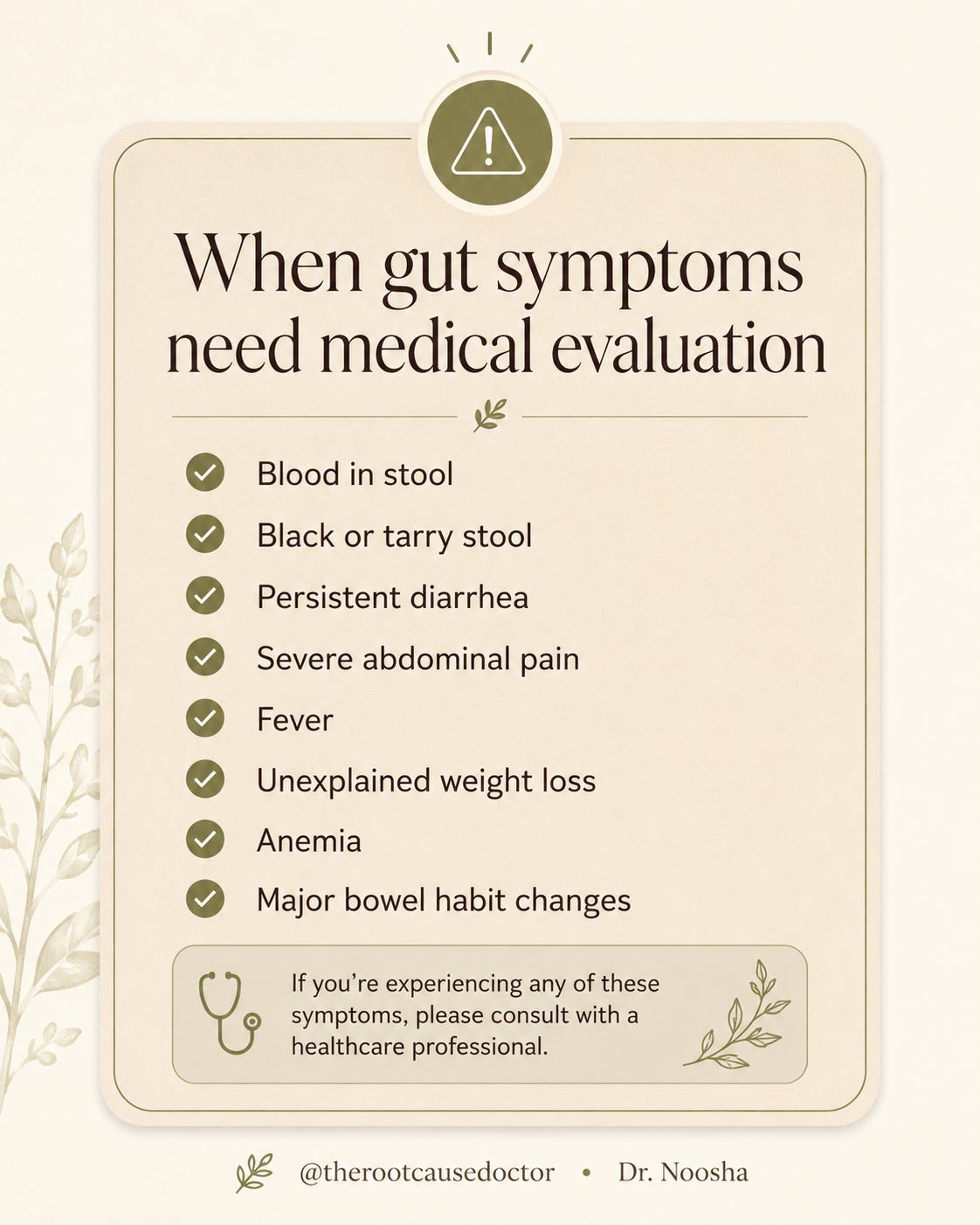
If there is blood in the stool, persistent diarrhea, unexplained weight loss, fever, severe pain, anemia, black or tarry stool, or a major change in bowel habits, that deserves appropriate medical care.
Functional medicine should never be used to bypass red flags.
A good root-cause approach knows when to support gently and when to investigate further.
3. Microbial balance
The microbiome is not just about having “good” or “bad” bacteria.
It is about balance, diversity, resilience, and context.
A stool test may show patterns related to beneficial bacteria, opportunistic bacteria, yeast, parasites, or microbial overgrowth signals.
But finding something on a stool test does not automatically mean it is the entire cause of your symptoms.
The better questions are:
How high is it?
Is it clinically relevant?
Does it match the symptoms?
Is the immune system reacting?
Is there inflammation?
Is digestion weak?
Is motility slow?
Is constipation present?
Is the nervous system in chronic stress?
Is the terrain making this organism more likely to overgrow?
This is where context matters.
Two people can have similar stool test findings and need very different support.
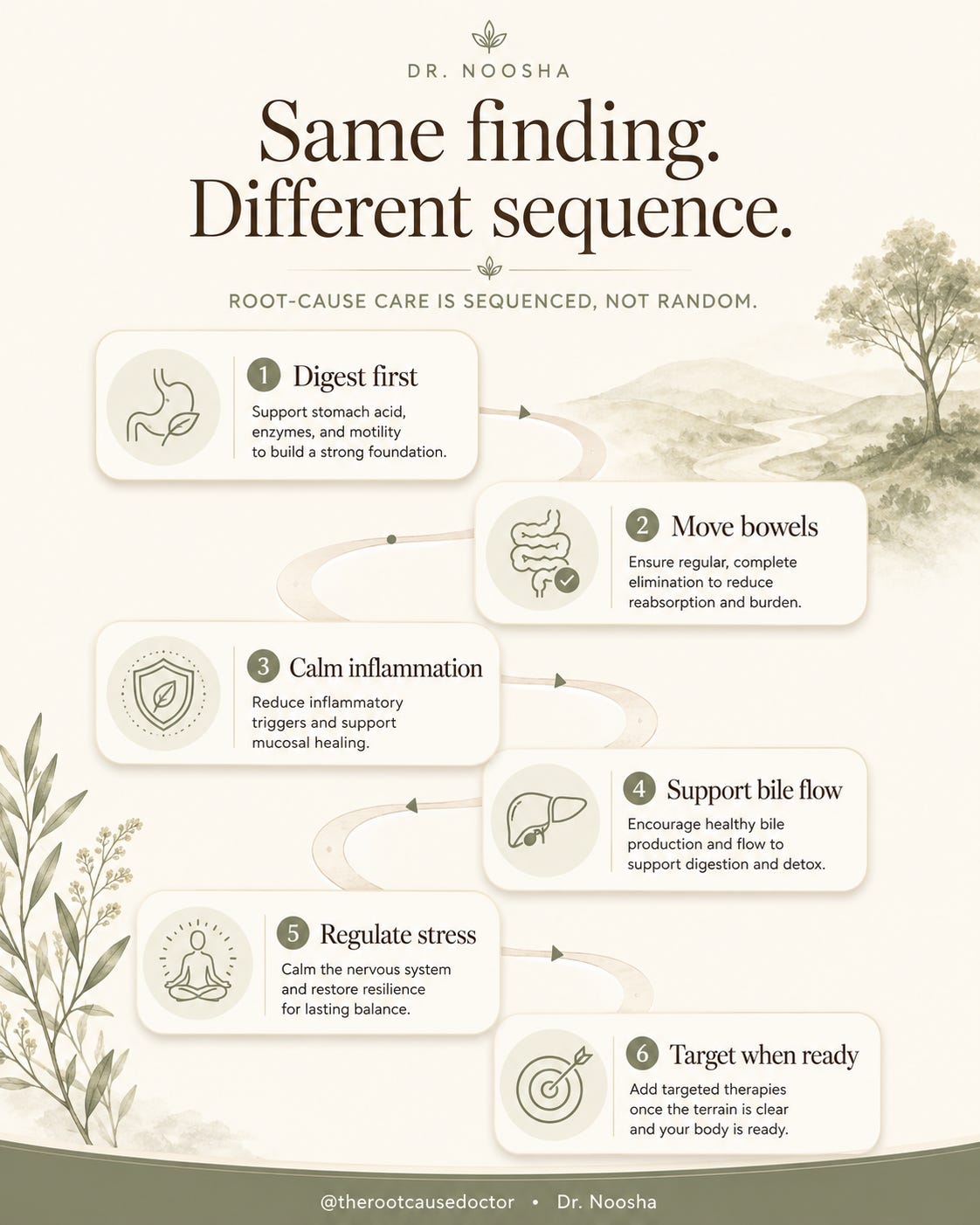
One person may need digestive support first.
Another may need constipation and bile flow addressed.
Another may need immune support.
Another may need a targeted antimicrobial approach.
Another may need nervous system regulation and motility support before anything aggressive.
Same finding.
Different body.
Different sequence.
4. Yeast, parasites, and pathogens
Yeast, fungal patterns, parasites, and pathogens can matter.
But they need nuance.
When yeast appears on a test, the answer is not always to jump straight into a “kill the candida” mindset.
When parasites or pathogens show up, the answer is not panic.
The better question is:
Why is this environment allowing this pattern to persist?
That may lead us to look at:
blood sugar
antibiotic history
immune resilience
constipation or slow transit
diet patterns
sleep
stress chemistry
travel or exposure history
timing of symptom onset
household symptoms
fever, blood, mucus, or weight loss
overall capacity to tolerate treatment
The organism matters.
But the terrain matters too.
The goal is not to wage war on the gut.
The goal is to understand why the ecosystem lost balance and how to restore resilience.
5. Gut immune activity
A large portion of the immune system interacts with the gut.
So when the gut is irritated, inflamed, dysbiotic, or under-supported, symptoms may show up beyond digestion.
Some people notice patterns like:
food reactions
histamine-like symptoms
skin flares
sinus congestion
fatigue
brain fog
mood changes
joint aches
hormonal flares around the cycle
This does not mean the gut is always the only root cause.
But it is often one of the central pathways to evaluate.
The gut is not separate from the immune system.
It is not separate from hormones.
It is not separate from the nervous system.
It is not separate from detoxification and elimination.
This is why functional stool testing can be helpful when symptoms feel scattered.
It can help us see whether the gut is part of the larger pattern.
6. Gut barrier stress
People often call this “leaky gut,” but I prefer to speak about it as gut barrier stress.
The intestinal barrier is not supposed to be a brick wall.
It is intelligent, selective, and responsive.
It is constantly communicating with your immune system, your microbes, your nervous system, and your food environment.
When the gut lining is irritated, the body may become more reactive.
Food may feel harder to tolerate.
Inflammation may rise.
The immune system may become more alert.
Symptoms may feel confusing and inconsistent.
But the answer is not always to restrict more foods forever.
Sometimes food sensitivity is not the first problem.
Sometimes it is a signal that the terrain needs support.
What a stool test does not tell us
A stool test can be powerful.
But it is not the whole story.
It does not tell me your full nervous system state.
It does not tell me your meal timing.
It does not tell me how safe your body feels.
It does not tell me your stress load.
It does not tell me how you sleep.
It does not tell me your cycle rhythm.
It does not tell me your blood sugar pattern.
It does not tell me what happened after antibiotics, birth control, pregnancy, trauma, grief, burnout, infection, or years of pushing through.
It gives us one important window.
But your body is the whole house.

That is why I do not interpret stool testing in isolation.
I interpret it alongside:
your symptoms
your timeline
your diet
your bowel habits
your cycle
your stress load
your sleep
your medications
your supplement history
your labs
your infection history
your nervous system capacity
your real life
Because the goal is not to treat the paper.
The goal is to understand the person.
Why I do not start with aggressive protocols
This is important.
A stool test may show dysbiosis, yeast, parasites, inflammation, or low beneficial bacteria.
But more aggressive support is not always better.
If someone is depleted, constipated, overwhelmed, undernourished, inflamed, or already reactive, jumping straight into “killing” protocols may make them feel worse.
This is where sequencing matters.
Before aggressive protocols, I want to ask:
Can the body eliminate well?
Is the person having regular bowel movements?
Is bile flow supported?
Is blood sugar steady?
Is protein intake adequate?
Is the nervous system regulated enough to tolerate change?
Is sleep supporting repair?
Are minerals and hydration in place?
Is the protocol matched to the person’s capacity?
The right support in the wrong order can still miss the pattern.
Sometimes we begin with foundations.
Sometimes we begin with medical evaluation.
Sometimes we begin with digestion.
Sometimes we begin with motility.
Sometimes we begin with inflammation.
Sometimes we begin with nervous system safety.
Sometimes we begin with targeted treatment.
The art is knowing the order.
When functional stool testing may be helpful
A stool test may be helpful when someone has patterns such as:
chronic bloating
constipation
loose stools or diarrhea
alternating bowel habits
mucus in stool
reflux or upper GI symptoms
unexplained food reactions
skin flares connected to digestion
brain fog after eating
fatigue with gut symptoms
suspected dysbiosis
history of frequent antibiotics
recurring GI infections
travel-related symptoms
suspected malabsorption
persistent symptoms despite basic support
complex gut-hormone-immune patterns
It may also be helpful when someone feels like they have tried “all the things” but still does not know what their gut is actually asking for.
But testing should always be used with discernment.
Not everyone needs advanced stool testing right away.
Sometimes the first step is more basic:
regular meals
protein
hydration
fiber tolerance
bowel rhythm
sleep
stress support
meal pacing
chewing
walking
supporting elimination
Your body often responds to what is repeated.
Daily Medicine matters.
The deeper point
Functional stool testing is not about obsessing over microbes.
It is not about fearing your gut.
It is not about finding everything that is “wrong.”
It is about listening more clearly.
It gives us a way to see patterns that may be hiding underneath symptoms.
It helps us understand whether the gut needs support with digestion, inflammation, microbial balance, immune activity, absorption, elimination, or resilience.
And when we combine that information with your story, your symptoms, and your capacity, we can make better decisions.
Less guessing.
More pattern recognition.
Less fear.
More context.
Less forcing.
More sequencing.
Because your body is not random.
Your symptoms are signals.
And the gut is often one of the places where the body has been trying to speak for a long time.
A grounded next step
If you are curious about functional stool testing, start by noticing your pattern before you order anything.
Ask yourself:
What are my bowel habits like?
When did my gut symptoms begin?
What makes them better or worse?
Do they change with stress?
Do they change with my cycle?
Do they change with certain foods?
Do I feel worse after antibiotics, travel, illness, or high-stress seasons?
Do I have red flags that need medical evaluation?
Have I already tried basic support without clarity?
Testing is most helpful when it answers a real clinical question.
Not when it becomes another way to chase every symptom.
Your body deserves more than guessing.
It deserves context, care, and the right support in the right order.
If your gut symptoms feel confusing, reactive, or connected to other symptoms in your body, this is exactly the kind of pattern we can map together in 1:1 root-cause care.
Want help mapping your pattern?
Explore 1:1 Root Cause Care:
Work with me 1:1 → Private Client Sessions
If your symptoms feel connected but you’re not sure what to support first, this is the kind of work I do in 1:1 root-cause care.

I offer single appointments and packages. If you’re unsure what’s best, email me at drnooshainfo@gmail.com 📧 and we’ll set up a discovery call.
The goal is not random guessing.
The goal is a clearer map and a wiser next step.
If someone you love is stuck in this loop, share this with them.
Thank you for being here.
Dr. Noosha🤍🙏🏽🦋
Follow on instagram: @therootcausedoctor || website: www.drnoosha.com
⚠️ Disclaimer: This is educational and not medical advice, diagnosis, or treatment. Please consult your licensed clinician before making changes. If symptoms are urgent or severe, seek proper & immediate care.